


Views: 0 Author: Site Editor Publish Time: 2026-07-21 Origin: Site


Purchasing industrial fabrication equipment represents a massive capital expenditure for any shop. The stakes are incredibly high. Make the wrong choice, and you will face severe material waste, workflow bottlenecks, and blown budgets. Upgrading from manual processes requires careful consideration. You need a system built for your exact material types and daily output demands. You must transition from simply knowing what a machine does to objectively evaluating specifications aligned with your production volume. Our guide provides a transparent framework for this evaluation. You will learn how to match technology types to your specific goals. We will help you assess hidden facility costs and prioritize vendor reliability. Review these insights before you sign any purchase order.
Machine selection must follow workflow: Do not overbuy automation if your primary output is standard straight cuts, but do not underpower your shop if processing hard materials.
True cost extends beyond the sticker price: Facility preparation, water management, and consumable wear drastically impact overall ROI.
Supplier support is a feature: Even top-tier machines become liabilities without responsive technical support and accessible spare parts.
Fabrication shops often hit a growth ceiling when they rely on manual tools or outdated equipment. Manual cutting restricts scaling. It drives up labor costs and exposes operators to physical fatigue. Furthermore, older equipment increases the risk of chipping high-value slabs. A single ruined slab of exotic quartzite can erase the profit margin of an entire project. Upgrading to a modern Stone Cutting Machine transforms this dynamic.
To justify the capital expenditure, you must define clear success criteria. A modern industrial saw should objectively reduce your daily cycle times. It must minimize operator error through digital measurements and automated feed rates. Most importantly, new equipment must maximize yield from expensive raw materials. Tighter nesting and cleaner cuts mean less waste per job.
Evaluating risk versus reward requires balancing the steep initial investment against predictable output. Advanced machinery reduces physical strain on your fabricators. It lowers workers' compensation risks and improves employee retention. When your shop delivers precise cuts predictably, you can take on larger commercial bids. You eliminate the guesswork from production timelines. The investment ultimately acts as a growth multiplier rather than a simple operational expense.
No single piece of equipment fits every fabrication environment. You must align the machine's capabilities with your daily output targets. Understanding the primary categories of fabrication technology helps you avoid costly misalignments.
Standard bridge saws serve as the workhorse for entry-level and mid-volume shops. They excel at straight cuts and simple edges. These machines suit businesses transitioning into semi-automated fabrication. However, they have distinct limitations. Standard bridge saws require significant manual material handling. Operators must manually rotate pieces and set up stops for different cut dimensions. They are robust but lack the agility needed for high-volume custom curves.
High-volume shops and custom architectural fabricators rely on CNC (Computer Numerical Control) machines. A 5-axis center provides unparalleled versatility. It handles complex curves, automated nesting, and high-precision architectural elements. The machine software reads digital templates and optimizes the cutting path. Operators step back while the machine executes intricate designs autonomously. This technology drastically reduces material waste and speeds up production.
Primary processing facilities require heavy-duty gantry setups. Block cutters are engineered specifically for slicing Big blocks of raw material down to workable slab dimensions. They use massive blade diameters and heavy steel structures to endure continuous, grueling operations. These machines sit at the top of the supply chain, converting quarried blocks into retail-ready slabs.
Modern ultra-compact surfaces and porcelain require specialized handling. Waterjet and sawjet combos provide hybrid solutions. They combine the speed of a circular diamond blade with the precision of a high-pressure waterjet. This combination allows for zero-tension cutting on brittle materials. It is the ultimate solution for intricate inlays, tight internal corners, and materials prone to stress fractures.
Machine Category Comparison Chart
| Equipment Type | Best Application | Automation Level | Primary Limitation |
|---|---|---|---|
| Standard Bridge Saw | Straight cuts, basic countertops | Low to Medium | Requires manual table rotation and setup |
| 5-Axis CNC Center | Complex curves, architectural elements | High | Steep learning curve for software |
| Block Cutter | Raw block to slab conversion | Medium | Requires massive floor space and foundation |
| Sawjet Combo | Ultra-compact surfaces, intricate inlays | High | High consumable and maintenance costs |
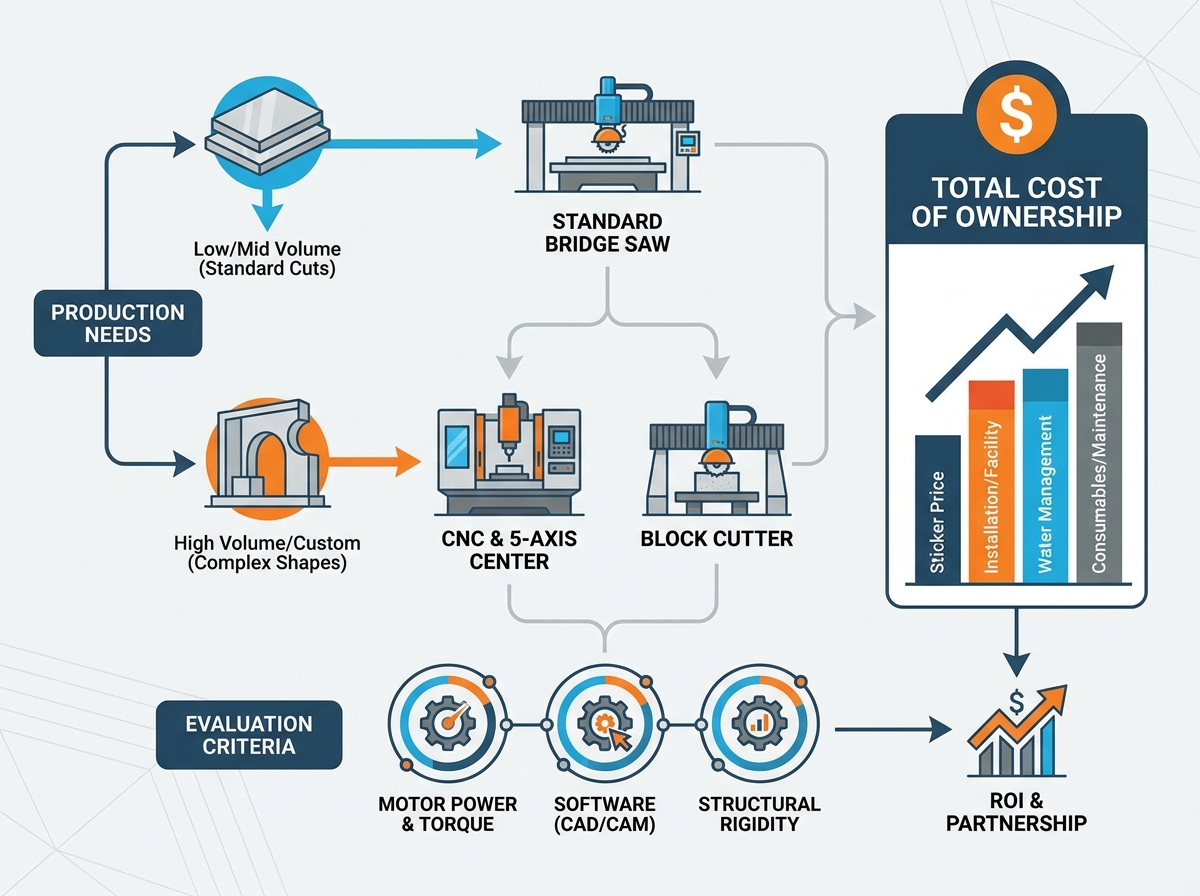
Once you identify the right category, you must evaluate the technical specifications. The wrong specs will leave your shop underpowered. Pay close attention to motor ratings, structural build, and digital interfaces.
Motor power dictates cutting speed and quality. Dense Natural stone, such as quartzite or premium granite, requires high continuous horsepower. If a motor lacks sufficient torque, the blade will stall mid-cut. Stalling damages the material and risks burning out the motor entirely. Look for machines offering direct-drive spindles with variable RPMs. Variable speeds allow you to slow down for hard materials and speed up for softer marbles.
Your typical material thickness must dictate your blade capacity. Standard 3cm countertop slabs require a different setup than thick dimensional architectural pieces. Ensure the machine accommodates the maximum blade diameter you need. Check the plunge depth capabilities. A machine that barely clears a 3cm slab will severely limit your ability to accept custom masonry jobs or heavy monument work.
Vibration is the enemy of a clean cut. Assess the machine's structural rigidity carefully. Manufacturers build frames from either cast iron or welded steel. Cast iron absorbs vibration exceptionally well. Heavier machine frames result in cleaner cuts and significantly longer blade life. A lightweight machine may cost less initially, but it will chatter during aggressive cuts, leading to edge chipping and premature tool wear.
Hardware means nothing without reliable software. Assess the learning curve of the operating system. Look for standardized, non-proprietary CAD/CAM software. It should integrate seamlessly with digital templating tools. If the software is overly complex, your operators will revert to manual methods. Ensure the system accepts standard DXF or DWG file formats for maximum compatibility with your field measuring tools.
Always test-cut your hardest typical material during a demo.
Verify that the spindle motor rating is continuous, not just peak horsepower.
Check the availability of software training modules for new hires.
Evaluating an equipment upgrade means looking far beyond the equipment itself. A common mistake buyers make is ignoring the infrastructure required to run heavy machinery. You must account for the entire installation ecosystem to determine true ROI.
Establish realistic budget ranges before engaging vendors. Entry-level bridge saws command a vastly different price than fully loaded 5-axis CNC machines. Understand what comes standard versus what is an optional upgrade. Features like tilting tables, laser guides, or digital cameras often cost extra. Clarify these details early to avoid budget shock later.
Industrial saws require robust infrastructure. You cannot simply plug them into a standard outlet. Account for concrete foundation work. Many large saws require deeply reinforced, perfectly level concrete pads to maintain calibration. Furthermore, you will likely need 3-phase electrical upgrades. Do not forget compressed air requirements. Pneumatic systems drive the pop-up rollers and tool changers. Upgrading your shop's compressor adds significant expense.
Cooling diamond blades requires massive water volume. A standard CNC saw can consume dozens of gallons per minute. You cannot dump slurry-filled water down a municipal drain. Factor in the cost of water recycling and filtration systems. Closed-loop pit systems or silo clarifiers protect your tools from dirty water while keeping your shop compliant with environmental regulations.
Calculate the ongoing operational costs based on projected uptime. High-speed equipment burns through diamond tooling rapidly if not calibrated correctly. Spindle maintenance, specialized grease, and hydraulic lubrication add up. Budgeting for these consumables ensures your cash flow remains positive during the first year of operation.
The relationship with your manufacturer begins, rather than ends, on delivery day. Even the most prestigious machines become liabilities if you cannot get them repaired quickly. You must vet your supplier as thoroughly as you vet the hardware.
Machine downtime kills shop profitability. When a saw goes down, production stops entirely. Vet suppliers on guaranteed technician dispatch times. Ask about their remote diagnostic capabilities. Modern CNC machines often feature internet-connected diagnostics. Factory engineers can log into your machine remotely to clear faults or update parameters without booking a flight.
A fast technician cannot fix a machine without parts. Confirm whether the vendor stocks replacement parts locally. If you rely on an overseas manufacturer with no regional warehouse, you face weeks of delay for simple components. Demand a list of standard wear parts and verify their domestic availability.
Ensure the contract includes factory-certified installation. A poorly leveled machine will never cut straight. Additionally, secure dedicated on-site training days for your operators. Complex CNC interfaces require professional onboarding. Insist on a training schedule that covers basic operations, daily maintenance, and troubleshooting.
Read the fine print on the warranty. Look closely at what the manufacturer excludes. Wear parts like belts, sensors, and sometimes even the main spindle might carry limited coverage. Some warranties void entirely if you experience specific electrical surges without an approved voltage stabilizer. Know your liabilities to avoid surprise repair bills.
Prioritizing the initial discount over local service availability.
Assuming basic electrical work is included in the installation fee.
Failing to document verbal promises regarding training hours.
Moving from research to procurement requires a structured approach. Narrowing down the market prevents decision fatigue and keeps your team focused on operational goals.
Footprint constraints: Measure your floor space, accounting for material loading zones and safety perimeters.
Capability baseline: Decide if you strictly need 3-axis cutting or if 5-axis interpolation is mandatory for your product line.
Weight limits: Ensure the machine table can handle the maximum weight of the blocks or slabs you process daily.
Never buy industrial equipment based on a glossy brochure or a scripted video. Request a live demonstration. Send your hardest-to-cut material directly to the vendor. Provide them with a complex DXF file from a recent difficult job. Watch how long it takes their technician to set up the cut and evaluate the final edge quality.
Demand contact information for two or three shops currently running the exact model you plan to buy. Call these references without the sales rep present. Ask them about the machine's reliability. Inquire about the manufacturer's response time during unexpected breakdowns. Real-world feedback remains your best defense against buyer's remorse.
Upgrading your fabrication capabilities requires looking beyond immediate bottlenecks. Buy for the capacity you will need in three years, not just the volume you handle today. A well-chosen industrial saw increases yield, protects your operators, and drastically reduces cycle times. Remember that the manufacturer is a long-term operational partner. Their commitment to service, training, and parts availability dictates your long-term success as much as the machine's structural rigidity.
Take the next step toward optimizing your shop's workflow. Gather your specific material requirements and footprint measurements. Reach out to factory experts to discuss customized configurations, request a technical consultation, or explore digital templating integrations. Equip your business with the right tools by getting in touch to build your perfect machine.
A: A high-quality industrial saw typically lasts 10 to 15 years. Lifespan depends heavily on structural rigidity, such as cast iron frames, and strict adherence to daily maintenance. Regular greasing, proper water filtration, and timely spindle servicing significantly extend the equipment's operational life.
A: Yes, but it requires variable RPM capabilities. Quartz and engineered materials are prone to burning or chipping at high speeds. Dense granites require high torque and specific diamond tooling. Operators must adjust feed rates and swap blades to match the material's hardness.
A: Basic operational competency takes about one to two weeks of hands-on training. However, mastering advanced CAD/CAM software for complex 5-axis architectural cuts can take several months. Vendors usually provide an initial 3-to-5 day intensive on-site training session during installation.
A: Yes. Heavy-duty equipment requires heavily reinforced, perfectly leveled concrete foundations. Standard shop floors cannot support the immense weight and dynamic vibration of a gantry block cutter. You must pour a custom pad according to the manufacturer's exact structural engineering specifications.


