


Views: 0 Author: Site Editor Publish Time: 2026-07-29 Origin: Site


Purchasing heavy industrial equipment represents a major capital expenditure for any fabrication facility. Getting this complex decision right dictates your daily production rhythm and long-term profitability. Selecting the wrong specification often leads to immense material waste. It creates severe production bottlenecks. You will inevitably experience unexpected and highly costly downtime. You simply cannot rely on glossy marketing brochures alone to make this choice.
We must evaluate machines based on rigid structural data and proven processing volume metrics. You need to understand long-term operational costs beyond the initial sticker shock. We will guide you through a highly practical evaluation framework. You will discover exactly how to match machine capabilities to your precise operational needs.
This systematic approach applies directly to secondary fabrication, heavy mining, or custom masonry requirements. Keep reading to learn exactly which mechanical specifications matter most for your shop floor. You will learn how to bypass vendor hype and secure the right tool for your specific material matrix.
Evaluate spindle power and structural rigidity based on the density of the natural stone you process most frequently.
Match bed size and axis capabilities to your production volume, especially when handling big slabs or complex architectural cuts.
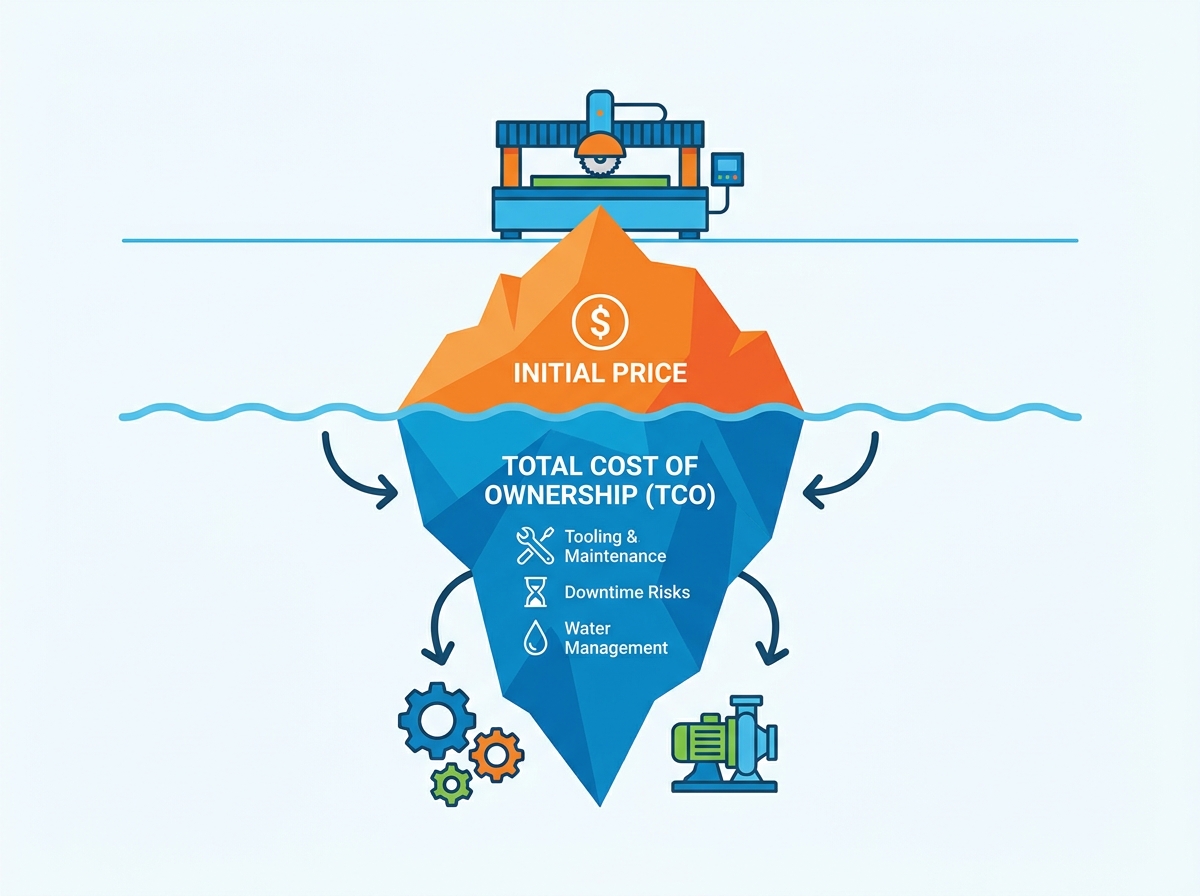
Assess Total Cost of Ownership (TCO) rather than just sticker price, factoring in tooling wear, water management, and software integration.
Prioritize vendor service Level Agreements (SLAs) and local parts availability to mitigate breakdown risks.
Before you evaluate any equipment, you must identify your core application precisely. Different shops require completely different machine architectures. We classify these operations into three main categories:
Primary Block Cutting: This involves heavy quarry-scale operations. You need massive structural frameworks. The equipment slices raw boulders into manageable slabs.
Secondary Fabrication: This focuses on custom countertops and architectural monuments. You need high precision for exact edge profiling. The machine must handle diverse material types daily.
Portable Site Work: This demands lightweight agility. Installers use these machines for final on-site adjustments. They sacrifice extreme power for essential mobility.
Next, assess the structural rigidity of the primary frame. You will typically choose between a mono-block design and foundation-mounted cast iron. Heavy-duty frames absorb vibration effectively. Vibration control remains strictly critical for achieving perfectly clean cuts. You need this stability when processing highly dense materials. A flimsy frame causes immediate blade chatter. It chips expensive edges on fragile slabs.
Define your success criteria based on your exact material matrix. Engineered quartz behaves much differently than granite. It requires unique cooling mechanisms. You also need specific RPM settings to prevent burning the synthetic resins. Ultra-compact surfaces like Dekton require extremely rigid structural bridges. Hard Natural stone like quartzite demands maximum continuous torque. You must align your chosen machine architecture perfectly with your dominant material type.
Motor horsepower (HP) and RPM limits define your ultimate cutting efficiency. Variable speed drives give operators precise control over the blade. You can adjust speeds dynamically for different material densities. A high-quality spindle maintains peak torque under heavy loads. Consistent torque prevents dangerous blade binding during deep passes. A standard production-grade Stone Cutting Machine typically offers between 15 to 25 HP. You need adequate power to slice through thick granite without slowing down. Undersized motors burn out quickly under continuous industrial use.
Cutting head articulation dictates your custom profiling capabilities. Evaluate your geometry requirements carefully before committing. Different axis configurations offer varying levels of automation:
3-Axis Capabilities: Ideal for standard straight cuts. You can perform basic profiling easily. They remain the dependable workhorses of standard fabrication.
4-Axis Capabilities: Offers automated head rotation for angled work. You can execute continuous miter cuts without manually turning the slab. This saves considerable staging time.
5-Axis Capabilities: Necessary for complex curved edges. You absolutely need this for automated sink hole routing. It provides full multidirectional interpolation for architectural custom pieces.
Blade compatibility also requires your strict attention. Check the maximum blade diameter capabilities on the specification sheet. Verify the arbor size standards against your current inventory. Ensure your equipment accepts standard industry diamond tooling. Proprietary tooling designs lead to expensive vendor lock-in. You want the absolute freedom to source blades competitively. Restricting your tooling options inflates your operational budget unnecessarily.
Worktable dimensions represent a rigid bottleneck for your entire facility. Evaluate the maximum X and Y travel distances carefully. The bed must accommodate your largest raw materials easily. Your suppliers frequently ship oversized slabs today to maximize yield. You need to fit these Big slabs without any manual repositioning. Manual adjustments waste precious time and increase error margins significantly. If the bed falls short, your daily throughput suffers immensely.
Table tilt and loading mechanics significantly impact your shop safety. Look for hydraulic tilting tables in your final specifications. They typically pivot from 0 to 85 degrees smoothly. A tilting bed allows you to load heavy materials safely. Forklifts can place slabs vertically against the tilted surface. It reduces operator injury risks dramatically. It also minimizes accidental material breakage during staging.
Vacuum manipulators transform your production flow entirely. Advanced CNC models often feature integrated suction systems. They move cut pieces automatically across the cutting bed. You need this feature for continuous processing of complex layouts. It allows operators to step away safely during nested cuts. Unattended processing maximizes your daily square footage output. It successfully removes the human bottleneck from material handling.
Control systems serve as the digital brain of your operation. Evaluate the User Interface (UI) extensively before buying. Operators accustomed to manual bridge saws face a steep learning curve. Is the touch screen highly intuitive? A confusing UI causes daily frustration and expensive programming errors. We strongly recommend testing the interface directly. Ask the vendor for a digital simulator if available.
CAD/CAM compatibility determines your actual workflow efficiency. Ask if the equipment requires proprietary design software. You want it to integrate seamlessly with standard drafting programs. AutoCAD and AlphaCAM remain powerful industry standards. Open integration allows your design team to work fluidly. It prevents costly software retraining across your entire staff. It also prevents file conversion errors during imports.
Camera integration provides massive financial returns for high-end shops. Overhead camera systems photograph slabs directly on the table. They align digital templates precisely over the actual stone grain. We call this highly profitable process digital vein matching. It proves absolutely crucial for high-end countertop aesthetics. Clients expect waterfall edges to flow perfectly together. It also minimizes expensive waste on luxury exotic materials.
Cooling systems directly affect your tooling budgets and cut quality. Assess the spindle and blade water delivery mechanisms thoroughly. You will primarily encounter internal and external water rings. Internal cooling delivers water straight through the spindle core. External halos spray the blade from the outside edge. Proper cooling extends your diamond tool life significantly. It prevents stone burning on sensitive engineered surfaces.
Water recycling compatibility demands careful verification from your facilities manager. Most modern shops run on closed-loop filtration systems. Determine the exact Gallons Per Minute (GPM) needs for the machine. Check the specific micron-filtration requirements in the operator manual. Muddy water will destroy spindle seals prematurely. You must filter particulates effectively to protect internal mechanics.
Cooling System Specifications Comparison
| System Type | Primary Benefit | Maintenance Need |
|---|---|---|
| External Halo Ring | Easy visual inspection and adjustment | Frequent nozzle cleaning required |
| Internal Spindle Feed | Superior core cooling for routing | Strict water filtration required |
| Hybrid Delivery | Maximum tool longevity and speed | Higher initial setup complexity |
Maintenance accessibility separates good machinery designs from frustrating ones. Are grease points easily accessible for your operators? Can they reach the linear guides quickly? Daily preventative maintenance must feel completely effortless. Hidden bearings usually get ignored by busy staff. Ignored bearings lead to catastrophic mechanical failures and downtime. Look for automated centralized lubrication systems if your budget allows.
Initial price rarely reflects the true financial impact of machinery. You must reframe the upfront price against your projected daily output. A cheaper manual saw might cut 200 square feet daily. A premium CNC model might push 600 square feet comfortably. Calculate your expected cost per square foot over a five-year timeline. This long-term metric provides a much clearer financial picture. It typically justifies investing heavily in automation upfront.
Hidden implementation costs surprise many new equipment buyers. Facility preparation requires substantial capital before delivery. You often need expensive concrete foundations poured to manufacturer specs. Complex machinery demands heavy 3-phase power installations. Proper water trenching adds significant labor expenses to the project. Rigging and heavy freight shipping can also consume thousands of dollars. You must budget for these vital infrastructure upgrades early.
Use a strict vendor evaluation checklist during your procurement process. Look for localized tech support availability in your specific region. Overseas-only troubleshooting causes agonizing production delays during breakdowns. Examine the standard warranty terms closely. Separate the parts coverage from the labor coverage explicitly. Finally, determine the exact cost of operator training programs. Extensive training ensures your team utilizes every feature safely.
The Bottom Line: A complex specification sheet only holds value when applied correctly. You must cross-reference those numbers with your specific shop bottlenecks. Every facility faces unique material types and operational labor constraints. What works beautifully for a high-volume commercial shop might fail in a custom boutique. Focus on structural rigidity, software compatibility, and vendor reliability.
Next Steps: Audit your current scrap rate today. Calculate the exact labor hours spent on manual finishing. These precise numbers will justify your next major equipment upgrade. They reveal clearly if you need better precision, more power, or advanced automation. Track your current machine downtime to build a solid business case.
Call to Action: Stop guessing about machine capabilities based on brochures. Request a custom return-on-investment calculation from your selected vendor. Ask for a live, in-person machine demonstration. Make them cut your most difficult daily materials. See the physical proof of precision before signing any purchase orders.
A: A standard production bridge saw requires at least 15 to 20 horsepower. Harder materials like quartzite and dense granites demand maximum torque. High horsepower prevents the blade from binding under heavy loads. This ensures a clean, straight cut while extending the life of your diamond tooling significantly.
A: A mono-block machine features a self-contained, highly rigid steel frame. It requires no poured concrete walls for installation. This design saves massive amounts of implementation time and facility cost. It also allows you to relocate the equipment easily if your shop layout changes in the future.
A: Yes, they operate extremely well with recycled water. However, you must meet strict micron-filtration requirements. Muddy or poorly filtered water contains abrasive slurry. This slurry will quickly destroy expensive spindle seals and internal cooling components. Always verify the specific GPM and filtration specs with the manufacturer.
A: A 3-axis machine only handles flat, straight cutting profiles. A 5-axis machine performs complex 3D shaping and continuous miter cuts automatically. This advanced articulation eliminates most manual edge finishing. The massive reduction in manual labor hours quickly justifies the higher upfront investment for busy fabrication shops.


