


Views: 0 Author: Site Editor Publish Time: 2026-07-17 Origin: Site


Upgrading to a commercial Carving Machine represents a high-stakes turning point for your shop. This investment directly impacts daily production bottlenecks, operational overhead, and overall product quality. Hobbyist routers no longer meet the stringent demands of scaling workflows. You must now balance heavy capital expenditure against necessary production capacity, essential machine rigidity, and your team's software learning curve. Making the wrong choice often leads to wasted materials, delayed fulfillment, and frustrated operators. This article provides an objective, evidence-based framework. We will help you evaluate the core hardware specifications and software ecosystems currently on the market. You will learn how to shortlist the exact machine perfectly suited to your specific woodworking business model, ensuring immediate efficiency and long-term scalability.
Machine rigidity and spindle power dictate production speed and material finish far more than advertised top travel speeds.
The true 3D wood carving machine price includes essential peripherals: dust collection, CAM software licenses, tooling, and specialized power drops.
Software compatibility and community/vendor support are critical risk factors that can make or break implementation timelines.
Selecting a wood carving machine for beginners transitioning to commercial production requires balancing intuitive interfaces with scalable hardware.
You must evaluate your daily operational needs before browsing equipment catalogs. Hardware specifications mean nothing unless they directly solve your current manufacturing limitations.
Assess your typical project flow. Do you handle low-volume, highly detailed custom orders? Or does your shop rely on high-speed, repeatable batch production? High-detail custom work demands exceptional accuracy and smaller cutting tools. Batch production requires rapid rapid-transit speeds and heavy-duty continuous operation. You need to align cycle time expectations against machine capabilities.
Your primary materials dictate the necessary spindle torque and frame rigidity. Cutting softwoods like pine requires vastly different forces compared to milling dense hardwoods like oak or maple. Processing sheet goods like plywood and MDF introduces highly abrasive glues. These glues wear down tools quickly. High-density materials demand a rigid chassis. A weak frame will flex under heavy cutting loads, ruining your surface finish.
Many buyers confuse a machine's cutting envelope with its required floor footprint. A 4x8 foot cutting bed requires significantly more shop space than simply 32 square feet. You must account for material loading clearances. Operators need safe walking paths around the gantry. Dust collection hoses and external control cabinets also consume valuable square footage.
Frame your purchase around future capacity rather than immediate project needs. Upgrading machinery frequently drains capital and disrupts workflows.
Evaluate your current maximum monthly output.
Project your expected sales volume three to five years from now.
Identify secondary product lines you might introduce later.
Choose a machine capable of handling those future demands effortlessly.
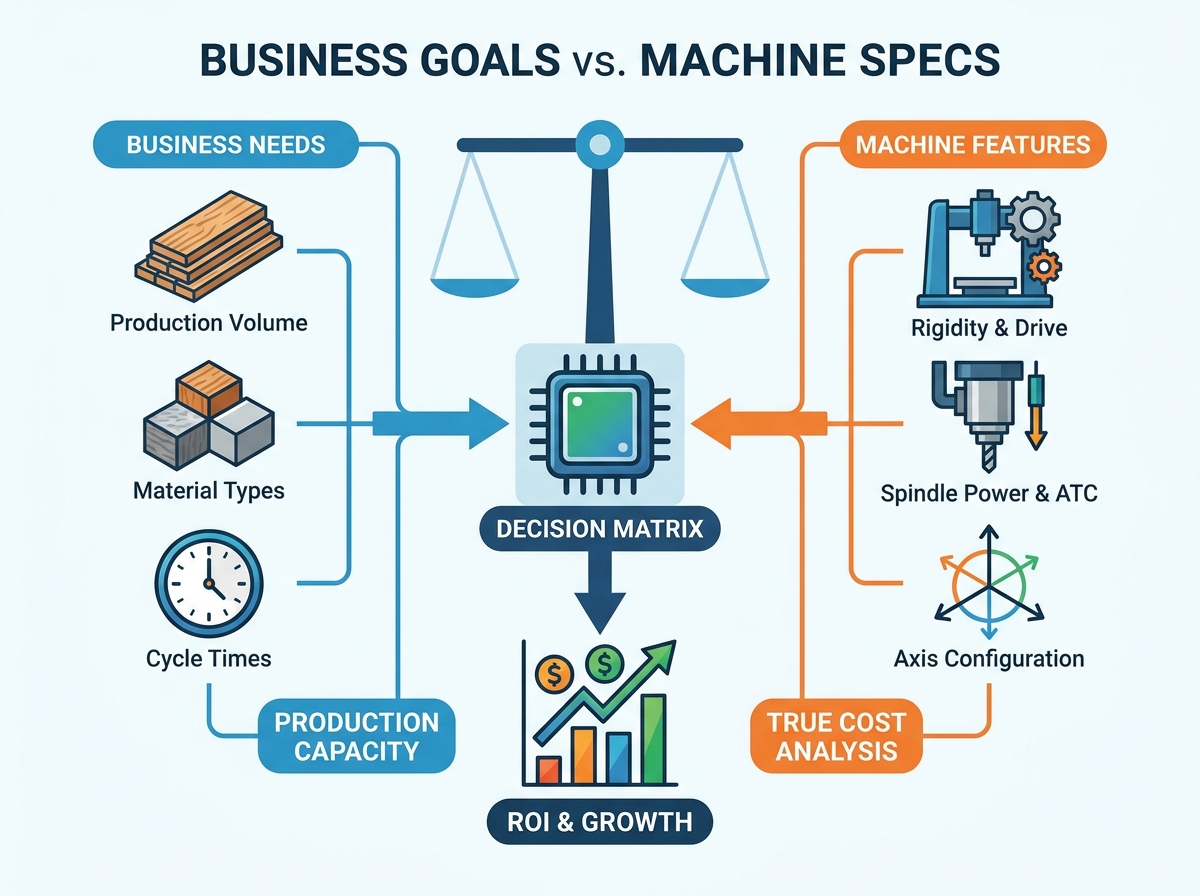
A reliable Wood Carving machine CNC relies on robust mechanical foundations. You cannot compromise on these core dimensions when stepping up to commercial manufacturing.
The chassis serves as the foundation for accuracy. Desktop machines often use aluminum extrusions. Commercial machines require cast iron or heavy welded steel frames. Steel dampens vibrations effectively. Less vibration translates to smoother cuts and longer tool life.
Drive systems translate motor power into movement. The technology you choose impacts both precision and maintenance schedules.
Drive System Comparison Chart
| Drive Type | Common Application | Accuracy Level | Maintenance Needs |
|---|---|---|---|
| Belt-Driven | Entry-level or laser systems | Low to Moderate | High (Belts stretch and snap) |
| Lead Screw | Z-axis or small desktop models | Moderate | Medium (Susceptible to backlash) |
| Ball Screw | High-precision commercial Z/X axis | Very High | Low (Requires regular lubrication) |
| Rack and Pinion | Large commercial X/Y axis (4x8+ beds) | High | Low (Self-cleaning teeth) |
Avoid belt-driven systems for heavy wood processing. Belts stretch under load, causing lost steps and ruined parts. Ball screws offer incredible precision for shorter travel distances. Rack and pinion setups dominate large format tables because they maintain speed over long distances without whipping.
Commercial operators must move beyond standard handheld routers. Dedicated spindles offer continuous duty cycles and quieter operation. Air-cooled spindles remain simpler to install. Water-cooled spindles run quieter and handle extended operating hours better in enclosed spaces.
You must also evaluate tool-changing logistics. Manual tool changes interrupt workflow. An Automatic Tool Changer (ATC) drastically increases output. If your shop runs complex files requiring three or four different bit profiles per sheet, an ATC pays for itself rapidly. It eliminates human error during tool height zeroing.
The controller interprets your design files into motor movements. PC-based controllers like Mach3 or Mach4 offer extensive customization. However, they rely on a standard computer operating system. Windows updates or background processes can interrupt cutting signals. Furthermore, consumer PCs remain highly vulnerable to airborne shop dust.
Standalone DSP (Digital Signal Processing) controllers offer a robust alternative. Operators use a handheld pendant to control the machine. DSP controllers operate independently of a PC. They resist dust infiltration and eliminate software crash risks during critical operations.
Adding more axes increases capabilities but drastically raises complexity. You must align the machine's geometry directly to your product catalog to find the ideal Wood carving machine 3D configuration.
Most woodworking shops thrive on 3-axis systems. The cutting tool moves left, right, forward, backward, up, and down. This setup proves perfect for standard relief carving, custom sign making, and flat-pack cabinet manufacturing. A rigid 3-axis machine handles 90% of traditional architectural millwork efficiently.
Some businesses produce table legs, custom pillars, or cylindrical carvings. A 4-axis setup adds a rotary indexer. The material spins along the X or Y axis while the spindle carves it. Evaluate your catalog before purchasing this upgrade. Rotary axes require specialized CAM programming strategies. They also consume valuable space on the machine bed when not actively used.
True 4-axis and 5-axis systems allow the spindle head itself to tilt and rotate. This enables high-end sculptural manufacturing and undercut machining. However, this capability introduces a steep jump in hardware costs. Software complexity increases exponentially. Most cabinet shops do not need 5-axis capabilities. We strongly advise against over-purchasing unless your business model explicitly demands complex aerospace or sculptural part production.
Many buyers focus solely on the sticker price. This oversight causes immediate budget overruns. You must uncover all hidden implementation variables to determine the real 3D Wood Carving Machine Price.
The manufacturer's invoice rarely represents your final expenditure. You must calculate the landed cost. Heavy machinery requires specialized freight shipping. You might need lift-gate delivery services. Unloading a 2,000-pound gantry often requires hiring professional riggers or renting a heavy-duty forklift. Budget an additional 10-15% of the machine price for transportation and placement.
A bare machine cannot operate effectively. You must acquire essential peripherals before production begins.
Industrial Dust Collection: Do not rely on shop vacs. Commercial routers generate massive chip volumes. You need a dedicated dust collector meeting specific CFM (Cubic Feet per Minute) requirements.
Vacuum Tables: Processing sheet goods requires secure work holding. Vacuum tables prevent material shifting. You will need a powerful, high-volume hold-down pump.
Tooling Library: High-quality cuts demand high-quality collets and carbide endmills. Build a robust starter library of compression, up-cut, and down-cut bits.
CAM software translates designs into machine code. Compare purchasing models carefully. Some programs like VCarve Pro offer perpetual, one-time purchase licenses. Others like Fusion 360 operate on subscription models. Subscriptions guarantee continuous updates but introduce recurring monthly overhead.
You can justify the initial capital outlay by calculating expected returns. Use a straightforward metric approach. Calculate the time saved per part compared to manual methods. Multiply this saved time by your standard hourly shop rate. Then, subtract the machine's monthly amortization cost and estimated tooling consumables.
A positive monthly number indicates a profitable investment. If the number remains negative, you either lack sufficient order volume or have over-specified your machine requirements.
Purchasing the hardware only completes the first phase. Integrating the equipment into your daily workflow presents numerous practical challenges.
Commercial equipment requires robust infrastructure. Evaluate your electrical panel early. Small machines run on single-phase 110V or 220V power. Industrial spindles and large vacuum pumps usually demand commercial 3-phase power. If your shop lacks 3-phase wiring, you must purchase expensive phase converters.
You also need environmental controls. Excessive humidity ruins MDF sheets and accelerates rust on linear rails. Extreme temperature fluctuations can impact the accuracy of electronic sensors.
Scaling a business requires staff training. A basic Wood carving machine for beginners might feature intuitive, plug-and-play software. Commercial machinery, however, demands deep CAM expertise. Operators must learn feed rates, plunge rates, and chip load calculations.
Acknowledge this reality early. Expect a drop in overall shop productivity during the first month. Dedicate specific team members to software training. Do not rush the learning timeline. Poor programming leads to broken tools and damaged equipment.
Hardware inevitably breaks under heavy commercial use. Your vendor's support ecosystem determines your downtime duration. Prioritize manufacturers offering domestic technical support. Clarify warranty terms before signing purchase agreements.
Investigate the machine's architecture. Does it use standard NEMA stepper motors and off-the-shelf variable frequency drives? Or does the vendor lock you into a proprietary ecosystem? Standardized parts allow you to source replacements locally. Proprietary systems force you to wait weeks for overseas shipping, crippling your production schedule.
Navigating the complex market of automated manufacturing requires discipline. The absolute "best" equipment does not exist in a vacuum. The right choice strictly aligns with your unique business constraints. You must balance your available capital budget, your physical floor space, and your current operator skill level.
Never base your final decision purely on marketing brochures. We highly encourage buyers to request physical sample cuts. Send your own proprietary CAD files to the manufacturer. Evaluate the edge finish and dimensional accuracy firsthand.
Take action today. Audit your current manual production bottlenecks. Document your most frequent material types and order volumes. Then, schedule a consultation with a qualified sales engineer to match these specific material needs against proven machine specifications.
A: Commercial hardwood carving requires continuous high torque. We recommend an absolute minimum of 2.2kW (approximately 3 HP) for dedicated routing. However, shops running full sheets of dense oak or maple daily should target 3.0kW to 4.5kW. Lower power models will stall or cause severe chatter during deep passes.
A: Yes, but you face severe logistical hurdles. Commercial units generate noise levels exceeding 90 decibels, violating neighborhood ordinances. Most residential panels lack adequate amperage or 3-phase capabilities. Furthermore, commercial activities in a residential garage often void standard home insurance policies. Always verify zoning and electrical capacities first.
A: Beginners break tools frequently while learning optimal feed rates. Commercial shops should budget between $1,000 and $2,000 for their first-year tooling library. This covers high-quality collets, a variety of solid carbide endmills (compression, V-bits, surfacing tools), and inevitable replacements caused by operator error or dulling from abrasive materials.
A: Used machines offer tempting upfront savings but carry substantial risks. You inherit worn linear bearings and potentially fatigued drive systems. More importantly, older machines often run on obsolete, unsupported proprietary software. Unless you possess strong mechanical troubleshooting skills and can independently upgrade the controller, a new warrantied machine provides better operational security.


