


Views: 0 Author: Site Editor Publish Time: 2026-07-17 Origin: Site


Many workshop owners face a common dilemma when expanding their production capabilities. You know both technologies process wood and acrylics effectively. However, they use fundamentally different mechanics—subtractive milling versus thermal vaporization. These underlying mechanics heavily dictate your end-product quality and daily workflow. Choosing the right Carving Machine requires looking far beyond basic specifications or flashy marketing claims. Carefully evaluate your shop environment constraints, ongoing consumable requirements, and true volume capabilities. Doing so helps you avoid costly production bottlenecks. If you select the wrong technology for your primary materials, you risk ruining expensive stock or creating severe safety hazards. This comprehensive guide breaks down the operational realities of both equipment options. We explore exact material limitations, software learning curves, and daily environmental demands in deep detail. You will discover practical strategies for matching machine specifications to your specific project needs. Ultimately, you gain the operational clarity needed to confidently finalize your purchasing decision.
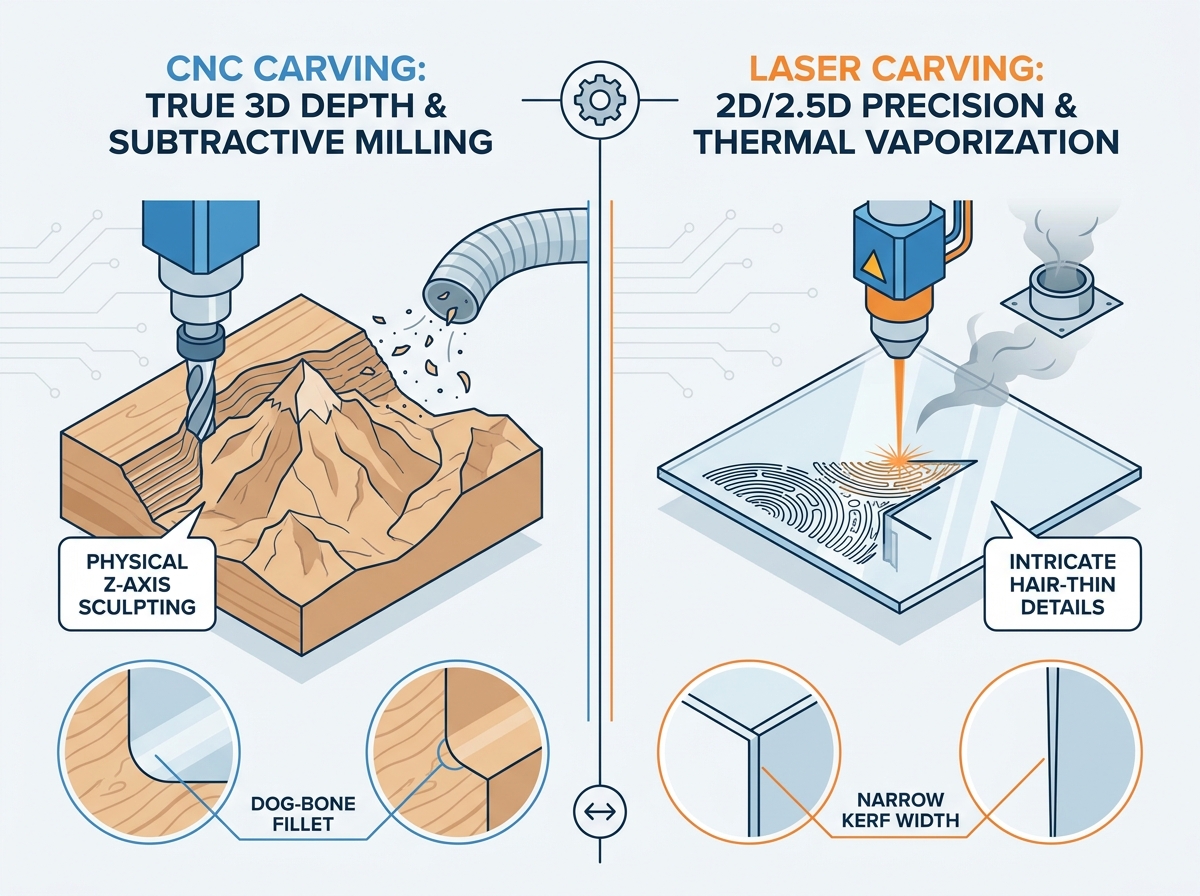
We need to thoroughly understand how each technology physically interacts with materials. Subtractive milling gives you complete, continuous control over the Z-axis. A Wood Carving machine CNC physically sculpts complex topography, creates sweeping chamfers, and carves deep multi-level pockets. The spinning router bit mechanically chips away solid material layer by layer. This mechanical action allows operators to produce true physical depth. Therefore, it remains ideal for creating topographical maps, custom guitar bodies, or intricate architectural corbels.
However, physical tool geometry imposes specific design limits. Because router bits are entirely cylindrical, they physically cannot cut perfectly square internal corners. When you attempt to route a square pocket, the bit leaves a rounded radius in the corners equal to its own diameter. Operators must creatively use "dog-bone" or "T-bone" fillets in their CAD designs. These fillets ensure mating parts, like wooden tenons or hinges, fit together smoothly.
Conversely, thermal vaporization acts as a highly precise, non-contact burning tool. Lasers function primarily as 2D or 2.5D tools. They engrave surfaces and cut flat sheets using intense focused heat instead of physical mechanical force. Because zero physical contact occurs, you never worry about lightweight material shifting from lateral cutting pressure.
The focused light beam features an incredibly narrow kerf, often measuring less than 0.1mm. This microscopic cut width allows you to achieve highly intricate, hair-thin details. Such sudden tight-radius movements would instantly snap a fragile router bit. You must, however, accept the "burn mark" trade-off. Lasers naturally char the edges of organic materials. You will need to account for mandatory post-processing steps. Operators routinely spend time sanding burnt edges or applying protective masking tape before cutting. This prevents surface smoke stains from ruining the final piece.
Your planned material inventory quickly dictates which machine you need. Certain substrates perform beautifully under a high-speed spinning end mill but catch fire instantly under a focused beam.
Let us examine what each machine handles best. Subtractive tools easily process thick hardwoods, dense polycarbonates, and specialized composites like carbon fiber or G10. You can even mill non-ferrous metals like aluminum, brass, and copper. You simply apply appropriate feeds, speeds, and cooling lubricants. Furthermore, mechanical milling creates no toxic off-gassing from the cutting action itself. The heavy chips simply fall away from the cutting path.
Thermal tools excel in an entirely different arena. They effortlessly process paper, delicate leather, synthetic fabrics, thin cast acrylics, and ultra-thin wood veneers. These fragile materials would instantly tear, fray, or shatter under the intense rotational torque of a mechanical spindle. When cutting fabrics or synthetic ropes, the beam simultaneously cuts and cauterizes the edge. This completely prevents future edge fraying.
Both technologies feature strict hard stops you must respect to maintain a safe shop environment.
| Material Type | Subtractive Milling Performance | Thermal Vaporization Performance |
|---|---|---|
| Thick Hardwoods (1"+) | Excellent (Produces true 3D depth) | Poor (Causes heavy charring, limited focal depth) |
| Paper, Leather, Fabric | Fails (Tears under spindle torque) | Excellent (Delivers clean, sealed edges) |
| Clear Cast Acrylic | Good (Requires manual polishing later) | Excellent (Leaves a flame-polished edge) |
| Non-Ferrous Metals | Good (Requires proper fluid cooling) | Fails (Requires specialized fiber laser) |
| PVC / Vinyl Sheets | Good (Safe to mill mechanically) | DANGER (Produces lethal chlorine gas) |
Machine footprint extends far beyond the physical chassis dimensions. You must account for massive auxiliary systems. These keep your workspace safe, clean, and fully operational.
Managing a mechanical milling environment requires significant physical preparation. Noise levels remain consistently high during operation. The high-pitch scream of a router cutting dense hardwood necessitates thick acrylic spindle enclosures. Operators must wear heavy-duty personal hearing protection at all times.
Debris management represents another massive environmental factor. Aggressive cutting generates extremely high volumes of fine sawdust and heavy flying chips. Installing a dedicated, high-capacity dust collection system featuring proper micron filters is absolutely non-negotiable. It protects operator lung health and prevents fires. Additionally, workholding demands constant manual intervention. You must physically secure every piece of stock using heavy toe clamps, strong double-sided tape, or complex vacuum tables. This vital step significantly adds to your overall setup time per job.
Managing a thermal environment presents a completely different set of challenges. The cutting process itself generates surprisingly low to moderate noise. Most ambient sounds come from exhaust blower fans and integrated air assist pumps. These blow compressed air directly onto the focal lens to prevent smoke damage.
However, indoor air quality quickly becomes your primary concern. Vaporizing organic material instantly generates thick smoke, noxious fumes, and dangerous fine particulates. You must invest in robust external venting ducts routing directly outside. If you operate in a basement or commercial space prohibiting external venting, you face a major hurdle. You will need expensive multi-stage filtration units featuring deep-bed carbon filters and HEPA layers. Safety also demands strict, unwavering protocols. You face a constant fire risk. Never leave the equipment unattended while cutting combustible materials like cardboard or plywood.
Software dictates how easily you translate a digital idea into a physical, profitable product. This specific area highlights a major difference in operator onboarding and daily friction.
If you are actively choosing a Wood carving machine for beginners, thermal options generally offer a noticeably shorter learning curve. Dedicated control programs, such as LightBurn, operate similarly to standard 2D vector graphic software. If you already know how to navigate Adobe Illustrator or Inkscape, you adapt incredibly quickly. The workflow feels highly intuitive. You simply import your vector design files. Next, you assign specific travel speeds and wattage power parameters to different color-coded layers. Finally, you press start.
Conversely, specialized CAD/CAM software requires a substantially steeper learning curve. You must develop a deep understanding of complex toolpath generation. Operators manually calculate optimal feed rates, safe spindle RPMs, and exact step-over percentages based heavily on material density. You cannot guess these numbers safely. You also need to manage expansive digital tool libraries and run complete 3D virtual simulations before ever powering on the machine.
Consider the operational risk of human error. Mechanical milling carries a notably higher risk of catastrophic user mistakes. A single incorrect Z-axis zeroing command forcefully crashes the spinning spindle straight into your MDF wasteboard. It can also shatter expensive metal clamps. Thermal machines remain relatively forgiving regarding mechanical crashes. Incorrect settings certainly waste expensive material or cause frustrating flare-ups. However, they rarely destroy the expensive gantry system itself.
Scaling your business requires analyzing how fast a machine turns raw stock into finished goods. Production speed drastically impacts your overall business capacity.
Thermal machines typically process multiple thin, intricate parts much faster. Because they cut via light, you never pause the machine to execute tedious manual tool changes. You can engrave a highly detailed logo, score folding lines, and cut the final exterior profile seamlessly. This happens all in one continuous operation. Consequently, they serve as absolute powerhouses for batch-producing wedding favors, personalized ornaments, or architectural models.
Milling machines process thin parts slower due to lateral force limits. However, they absolutely dominate when dealing with thick stock. Subtractive workflows yield significantly higher profit margins on thick, custom-sculpted items. While it takes time to hog out large pockets of hardwood, the resulting product holds immense structural value. You can easily produce robust furniture parts, thick custom cabinetry components, and massive exterior business signs. A flat laser beam simply cannot replicate these heavy items.
Selecting the perfect equipment ultimately boils down to aligning mechanical capabilities with your unique daily workflow requirements. Review this targeted matrix before making your final purchase.
Choose subtractive milling if:
Choose thermal vaporization if:
Ultimately, neither technology holds a universal advantage over the other. Their true value depends entirely on your specific commercial applications, raw material preferences, and physical workspace constraints. They represent two entirely different approaches to manufacturing.
To confidently finalize your strategic expansion, take these specific, actionable steps today:
A: This heavily depends on the task. Lasers operate much faster and hold higher precision for 2D profile cuts on thin materials due to their incredibly narrow kerf. However, subtractive machines act drastically faster when forcefully removing large volumes of material. They also hold much tighter structural tolerances for functional, mechanical 3D joinery where parts must physically interlock.
A: Technically yes, you can utilize 3D grayscale engraving. This specific process varies the beam power to burn incrementally deeper into the material. However, it operates incredibly slowly and leaves heavily charred, sloped surfaces. It simply cannot match the smooth, highly precise physical depth seamlessly created by a dedicated mechanical spindle.
A: Milling machines require routine mechanical lubrication, precise gantry squaring, frequent wasteboard resurfacing, and constant bit replacements. Thermal machines require delicate optic cleaning, exact mirror alignment calibration, regular water chiller fluid maintenance, and eventual glass tube replacements as the internal gas naturally depletes over years of use.


